In the face of escalating energy expenses and mounting ecological concerns, the bitcoin mining sector is embracing a wave of innovation. This evolution is not just about survival; it's about pioneering a path to a sustainable and profitable future. Beyond endurance in a challenging market, today's bitcoin miners are flourishing. They're harnessing the power of state-of-the-art cooling solutions and innovative operational tactics to ensure profitability in an environmentally conscious manner.
Innovative cooling solutions are at the heart of transforming bitcoin mining's energy profile. Isaac Holyoak from CleanSpark describes the leap forward: "Advanced cooling technologies are pivotal for enhancing our mining efficiency while reducing our environmental impact." By moving to colder regions and utilising smart airflow designs, mining operations achieve significant energy savings.
Immersion cooling, a method where mining hardware is submerged in a special coolant, further diminishes the reliance on energy-intensive cooling methods. Holyoak elaborates, "By maintaining optimal temperatures through immersion, we're seeing a surge in hash rates without a parallel increase in power consumption." This technique not only conserves energy but also prolongs the lifespan of mining equipment, setting a new standard in mining rig efficiency.

The integration of advanced technologies such as immersion cooling into the bitcoin mining process has broader implications. Initially refined at scale by bitcoin miners, these more mature technologies are now being adopted by traditional data centres. This crossover of innovation underlines the potential for mining technologies to enhance energy efficiency across various industries.
But innovation doesn’t stop at cooling. Bitcoin miners are now repurposing excess energy. The unused byproduct heat from mining is diverted for agricultural use or returned to the power grid, transforming a cost centre into a revenue stream.
The strategic repositioning of mining operations to areas with cheaper energy and more renewable sources highlights the practical impact of these innovations. James Behan of Chainergy provides a stellar example with their circular economy model. By using biomethane derived from local pig slurry and maize, they power their mining operations, slashing the carbon footprint and even supplying excess energy back to the community grid.
This approach not only strengthens their bottom line but also represents a leap towards sustainability. "Our method not only adheres to circular economy ideals but also significantly diminishes the environmental impact of our activities," remarks Behan. Choosing the right location can be good for both the environment and profits.
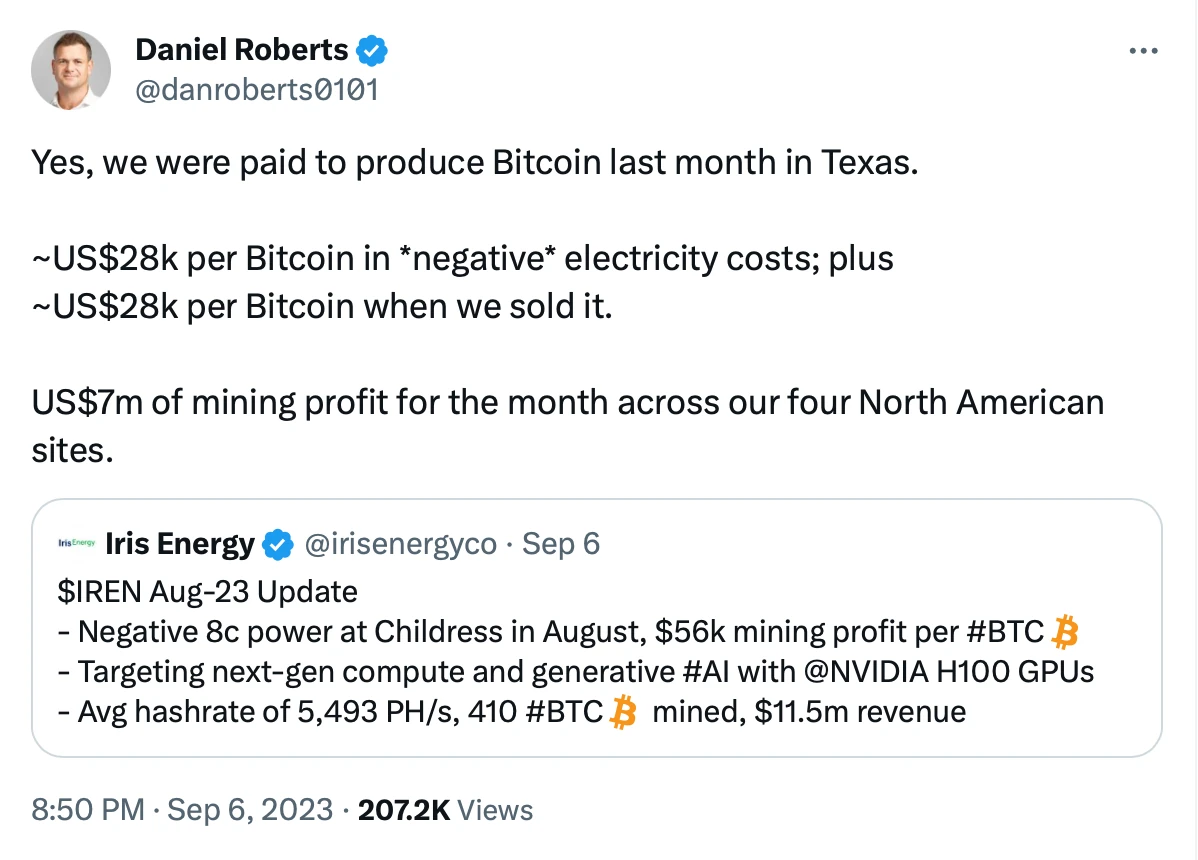
Partnerships are also key. Miners are joining forces with energy utilities to stabilise local power grids. Daniel Roberts of Iris Energy highlights their approach: "When the wind blows, and the sun shines - take power and mine bitcoin. But when there is a weather event, we can nearly instantly put miners to sleep and give power back to the market." This not only maximises the use of renewable energy but also presents miners as problem-solvers for grid stability.

Bitcoin miners are forging symbiotic relationships with energy utilities. They're no longer mere energy consumers; they're stabilising partners for local power grids. By providing flexibility to the energy market, they help to balance supply and demand, often receiving incentives for their contributions.
Miners like Iris Energy are not only being paid for mining bitcoin but also for playing a key role in stabilising the local power grid. "Our facilities are engineered to rapidly adjust operations in response to grid demands, effectively acting as a demand-side battery during extreme weather events," states Roberts. "By leveraging sophisticated software, we can swiftly power down and contribute excess energy back to the grid when it's needed most, ensuring we're a profitable and responsible part of the energy ecosystem."
CleanSpark is pioneering the fine-tuning of ASIC miners through 'underclocking' and 'overclocking' techniques, optimising the balance between energy consumption and computational efficiency. Isaac Holyoak highlights the effectiveness of their approach, noting, "By strategically underclocking, we mine the equivalent of 1.3 bitcoin for the energy typically required to mine a single one." This technique ensures that miners maximise their output, while adhering to sustainable energy practices.
However, the sector’s drive for efficiency is not without its challenges. Behan notes the precarious nature of subsidy schemes, which once spurred growth but now, with changing regulations, threaten stability. Yet, the industry’s resolve remains unshaken, with miners like Chainergy continuing to adapt and innovate.
Bitcoin mining is undergoing a transformative phase. It is an industry pivoting with agility, combining technological prowess with strategic ingenuity. From advanced cooling to renewable energy usage, and from grid stabilisation to circular business models, bitcoin miners are not only forecasting the future; they are actively constructing it. These miners are highlighting the reality that profitability now goes hand-in-hand with sustainability.
These narratives and testimonies from the field reveal a sector that is as resilient as it is revolutionary, underpinning the next chapter in bitcoin's ascent, where profitability aligns with ecological responsibility. As the industry navigates through economic and environmental mazes, these concrete innovations and real-world strategies guide the way towards a sustainable and profitable future in bitcoin mining.
As we uncover the success stories of these innovators, it's evident that bitcoin mining's future is being rewritten. It's a narrative that's no longer dominated by the high environmental costs but by the incredible potential for sustainable practices to drive the industry forward. Bitcoin miners have shown that with the right mix of technology, strategy, and commitment to sustainability, it is possible to not only stay afloat in challenging times but also to thrive while setting a new standard for the industry.