European banks spend billions checking customers and monitoring transactions for money laundering, but auditors have found that financial authorities have failed to properly assess whether their oversight works.
Eight Dutch banks examined by auditors spent approximately €1.6 billion on anti-money laundering compliance in 2024, while a separate legal battle has exposed a dispute over hundreds of documents that the Dutch central bank refused to provide even for confidential judicial inspection.
The report, published on October 9, 2026, examined how financial authorities oversee anti-money laundering requirements in the Netherlands, Germany, Spain and Cyprus. None of the national supervisory authorities had specifically evaluated its effectiveness. Poland also contributed findings from an earlier audit.
Between 2021 and 2024, compliance costs rose 16.7% after adjusting for inflation. Auditors also documented customers losing access to bank accounts, difficulties transferring money abroad and signs of discrimination.
The findings come as the European Union prepares to introduce new AML requirements covering banks and cryptoasset service providers. Financial monitoring is set to expand, despite the lack of dedicated assessments showing how effectively existing oversight helps combat money laundering.
Billions Spent, Effectiveness Not Known
European anti-money laundering rules have expanded through successive directives since 1991. Banks must verify customers’ identities, monitor transactions and report unusual or suspicious activity to national authorities. The stated aim is to prevent criminals from moving illicit funds through the financial system.
The Financial Action Task Force, which sets global anti-money laundering standards, still cites an estimate dating back to 1998 that money laundering accounts for between 2% and 5% of global GDP. The original figure came from the International Monetary Fund, which acknowledged the difficulty of measuring illicit activity.
Nearly three decades later, the same range remains in use, although it does not establish whether money laundering has increased or decreased over that period.
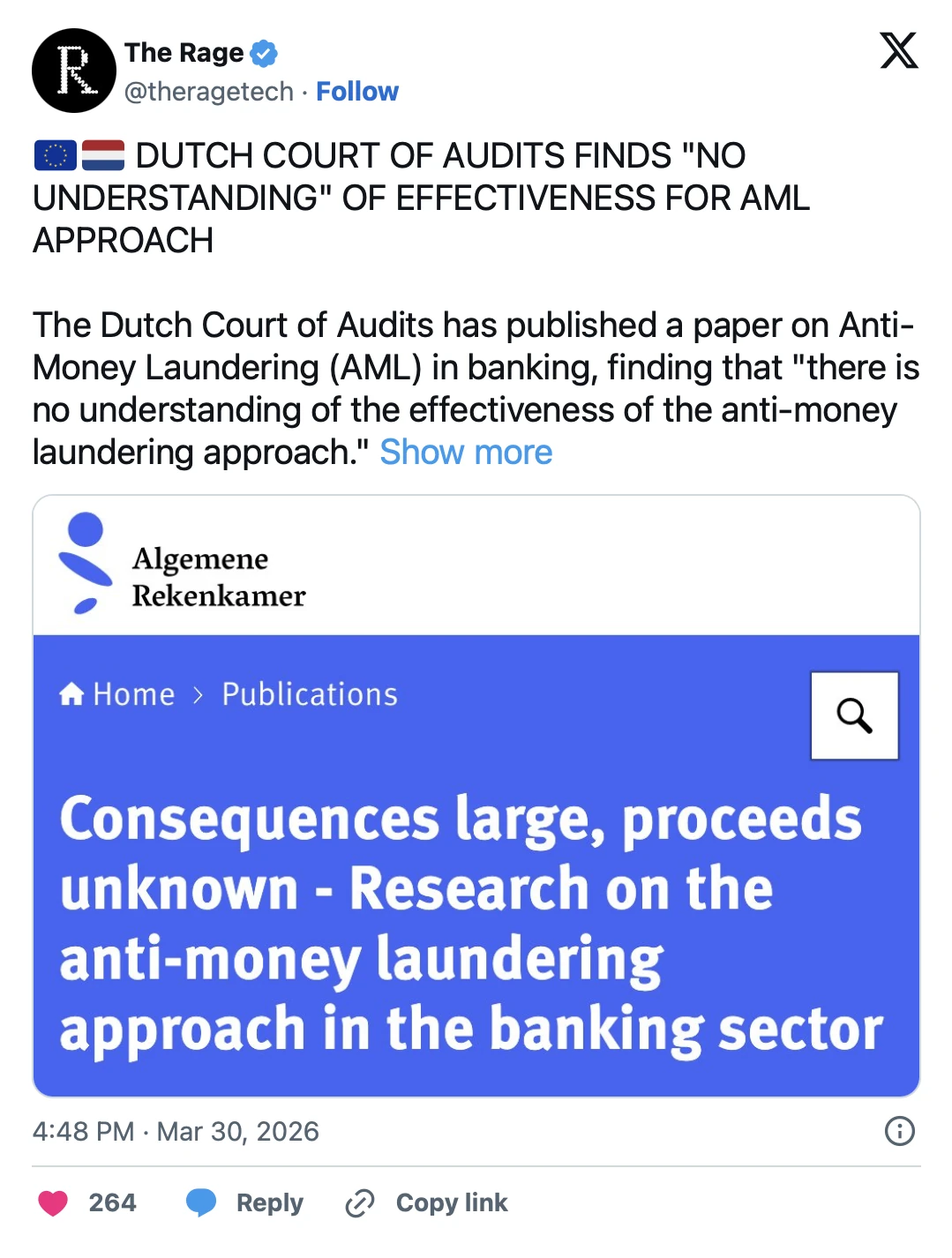
A March 11, 2026, investigation by the Netherlands Court of Audit found that Dutch banks reported nearly 250,000 unusual transactions in 2020, rising to more than 530,000 in 2024. Despite the increase, the auditors could not establish how effectively these reports contributed to preventing or detecting money laundering.
The scale of the operation is substantial. The banks employed approximately 13,000 full time equivalent staff to combat money laundering in 2024, while the auditors also identified significant differences in the quality of reports submitted to the country’s financial intelligence unit.
The investigation also documented the consequences for banking customers, particularly politically exposed persons and religious organisations. Migrant churches and mosques faced greater difficulties than Catholic and Protestant churches, while the auditors identified signs of discrimination in how customers were treated.
The consequences extend beyond additional paperwork. The auditors found cases where people and religious organisations struggled to open bank accounts, lost access to existing accounts or were unable to transfer money to relatives abroad. Financial monitoring can therefore affect people’s ability to support their families and carry out ordinary activities, even where no criminal wrongdoing has been established.
Tom van Lamoen, a representative of the Libertarian Party in the Netherlands, criticised the scale of the requirements and their impact on ordinary people.
“Fighting financial crime should mean targeting criminals, not treating everyone as a suspect,” he told Forbes.
The Netherlands Court of Audit concluded that the country’s approach to money laundering was insufficiently effective and efficient. It found that De Nederlandsche Bank, the Dutch central bank, had not evaluated the effectiveness of its oversight, while the country’s financial intelligence unit did not assess the quality of reports submitted by banks. Despite substantial spending and an increasing number of reports, the authorities lacked the information needed to establish whether their approach was targeting the greatest risks.
The findings highlight the disconnect between the growing scale of financial monitoring and the evidence available to demonstrate its effectiveness. Banks face extensive compliance obligations, while the authorities responsible for enforcing them have not established how much their oversight contributes to tackling financial crime.
A Dutch Monitoring Program Faces Legal Scrutiny
The Dutch investigation also points to a different problem. As financial institutions collected and analysed growing amounts of customer information, questions emerged about the legal limits of those activities and the central bank’s role in overseeing them.
Internal DNB presentations describe techniques including risk scoring, network analysis and identifying unusual patterns in financial activity.
One presentation, titled Outlier Detection, describes analysing customer and transaction data from large Dutch banks, potentially covering millions of clients and billions of transactions. The records describe pseudonymised data being loaded into a database to identify cases for further investigation.
A 2022 Financial Action Task Force evaluation confirmed that DNB had used an anomaly detection model on a dataset containing more than 300 million transactions and approximately 7.5 million clients. The total volume processed across its supervisory activities remains unknown.
Five Dutch banks also established Transaction Monitoring Netherlands, a joint initiative designed to identify suspicious activity by analysing transaction data across participating institutions. The banks were ING, Rabobank, ABN AMRO, Triodos Bank and de Volksbank.
On July 1, 2024, TMNL announced that it would wind down its existing activities and redesign its operations to align with forthcoming European legislation. The organisation said the changes would provide greater legal clarity for cooperation between financial institutions.
TMNL was contacted for comment on the scope of its monitoring activities, the legal basis for processing customer transaction data and the reasons its original operations ended in 2024. No response had been received by the stated deadline.
The initiative attracted opposition from Human Rights in Finance EU, an organisation that challenged the legal basis for sharing customer transaction data. Simon Lelieveldt, a board member of the organisation, has spent years questioning the arrangement and DNB’s role in supervising it.
In correspondence with Forbes, Lelieveldt accused DNB of breaching the EU General Data Protection Regulation, particularly Recital 31, which places limits on public authorities’ requests for personal data. He argues that the problems involve “not just the banks but the supervisors as well,” maintaining that DNB’s large collection and analysis of customer information exceeded those limits.
The dispute has since reached the courts, although the proceedings concern access to documents rather than a judicial finding that the monitoring was unlawful. In separate proceedings, a Dutch appeals tribunal dismissed a challenge to TMNL’s monitoring arrangements in September 2026 because the activities had already ceased, without determining whether they had been unlawful.
The 362 Documents DNB Refused to Hand Over
The Dutch central bank refused to provide 362 documents concerning transaction monitoring, even for confidential examination by a judge. DNB argued that the records were protected by supervisory confidentiality, triggering a legal dispute that has reached the Netherlands’ highest general administrative court.
The case began when Human Rights in Finance EU requested records concerning TMNL and DNB’s supervisory approach. Of the 566 relevant documents identified, the central bank argued that more than half were protected by supervisory confidentiality and fell outside Dutch freedom of information law.
In a June 5, 2026, ruling, the Amsterdam District Court examined DNB’s refusal to provide those documents for confidential judicial inspection. The court found that it could not properly assess whether the information had been correctly withheld without examining the material.
DNB appealed the ruling. On August 27, 2026, the Dutch Council of State allowed the central bank to postpone reconsidering its disclosure decision until the appeal had been resolved.
The central bank was contacted for comment on its transaction monitoring activities, its relationship with TMNL and its refusal to provide documents for confidential judicial inspection. DNB did not respond to the questions before the deadline.
The proceedings have not established that the underlying monitoring was unlawful. They have, however, exposed a dispute over whether documents concerning financial surveillance can be withheld from judicial examination on grounds of supervisory confidentiality.
Warnings Reached the Central Bank’s Leadership
Documents provided to Forbes show that concerns about financial surveillance were raised directly with the email account of Klaas Knot, who was president of DNB at the time.
On April 7, 2024, Human Rights in Finance EU sent Knot an email challenging the central bank’s approach to transaction monitoring. The organisation argued that the collection and sharing of customer financial information was disproportionate and called for DNB to intervene.
A read receipt dated April 23, 2024, records that the message had been opened. Although the notification does not establish who read it or what action was taken, it provides evidence that the warning reached Knot’s email account.
Lelieveldt told Forbes that he received no personal response from Knot, although his organisation continued its correspondence and legal proceedings with DNB.
The correspondence comes as Knot’s candidacy for the presidency of the European Central Bank attracts renewed attention. His personal involvement in the disputed monitoring arrangements has not been independently established.
Europe’s Next AML Rules Are Approaching
Europe is preparing to tighten its financial monitoring framework, even as its own auditors question whether existing oversight is delivering results. An Anti-Money Laundering Regulation adopted in 2024 will apply across European Union member states from July 10, 2027, bringing more uniform requirements for banks, financial institutions and cryptoasset service providers.
Under Article 40, cryptoasset service providers will be required to assess the risks of transfers involving personal wallets that customers control themselves. Depending on those risks, providers may need to verify identities, request information about the origin or destination of funds, or monitor transactions more closely. The rules do not prohibit individuals from holding Bitcoin in their own wallets, but they increase the scrutiny that can accompany transfers involving regulated businesses.
The EU is also expanding centralised oversight through its new Authority for Anti-Money Laundering and Countering the Financing of Terrorism. The authority will select up to 40 financial institutions or groups for direct supervision in 2027, with oversight beginning in 2028.
For Bitcoin users, financial monitoring already extends beyond the rules arriving in 2027. The EU Travel Rule requires regulated cryptoasset providers to collect information about senders and recipients, including transfers involving personal wallets. Separate tax reporting requirements introduced in January 2026 under the Crypto-Asset Reporting Framework require providers to collect reportable transaction information for sharing with tax authorities. These obligations increase the amount of personal and financial information held by regulated businesses and government agencies.
The risks of collecting financial information can extend beyond privacy and banking access. When identity records are linked to Bitcoin holdings or blockchain addresses, a data breach can expose both an individual’s wealth and their location, potentially making them a target.
Research published by Gart on November 12, 2026, documented 841 physical attacks involving cryptocurrency across 77 countries since 2014, alongside a separate record of 304 personal data leaks.
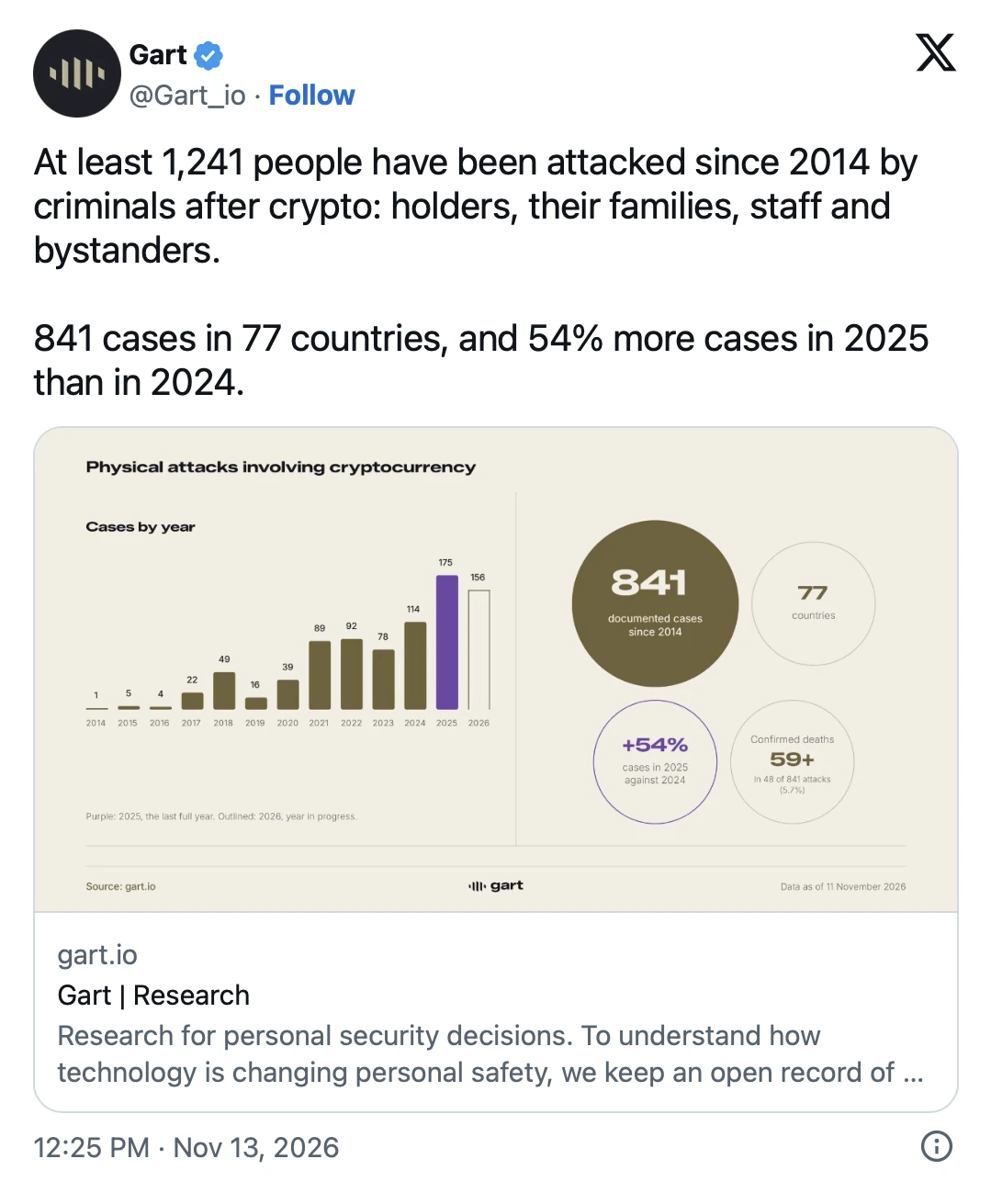
In four cases, a recorded leak was followed by a physical attack, while French reporting has linked stolen customer information from cryptocurrency tax software provider Waltio to attacks on households. These findings do not implicate the monitoring systems examined in the European audit, but they provide documented examples of the physical security risks associated with exposing sensitive financial information.
Combating financial crime is an important objective, but the measures used should be effective, proportionate and subject to scrutiny. The European audit found serious shortcomings in how authorities assess their results, while the Dutch investigation documented the consequences for ordinary banking customers.
Financial monitoring is set to expand, bringing additional costs and the collection of more sensitive information. The evidence leaves European authorities with a difficult task. They must demonstrate that the benefits justify the financial costs, restrictions on banking access and risks to personal privacy and security.