Over the past decade, what constitutes real money has transformed. At the centre of this financial evolution is bitcoin, the world's first decentralised digital currency.
Traditionally, our reliance on government-issued fiat currency has been the norm. However, with influential entities like X (formerly Twitter) and Facebook shaping global discourse, the potential for reshaping currency standards becomes evident. A grassroots monetary approach is gaining momentum, designed to empower people by the people.
Satoshi Nakamoto, the person or group behind bitcoin's creation, founded a digital monetary system that decentralises power and operates on cryptographic principles. In this context, decentralised refers to the absence of a single controlling authority, like a central bank, overseeing or regulating the currency. Instead, bitcoin operates across a network of computers where transactions are verified by participants, known as miners. This decentralisation is a nod to a movement favouring financial autonomy and reduced reliance on traditional institutions, positioning people at the heart of the monetary system.
Traditional definitions of money dictate that it should serve as a medium of exchange, a unit of account, and a store of value. Against these criteria, bitcoin stands tall.
Bitcoin's utility as a store of value is underpinned by its scarcity, decentralised nature, and potential for long-term growth, distinguishing it from traditional assets like gold. In the digital age, bitcoin's ability to preserve wealth and offer an alternative to traditional stores of value makes it a compelling option for investors and individuals alike, with a notable increase of over 6,000% in value since 2016, despite the volatility.
Analysis shows bitcoin's transaction volume is on a consistent upward trend, with increased merchant adoption and a robust market capitalisation. The growing strength of bitcoin's network effect is well-detailed by Lyn Alden in her article, Analyzing Bitcoin's Network Effect. Plus, its hash rate is continually setting new records.
The count of bitcoin addresses holding 1 BTC, 0.1 BTC, and 0.01 BTC keeps rising. Estimating the exact number of bitcoin or other digital asset users is challenging since one address does not always mean one person. Big addresses might represent accounts for many users or exchanges, while some large users spread their bitcoin across multiple addresses. Still, the growing number of smaller addresses is a positive sign for adoption.
Delving deeper into the history of money, Nick Szabo's concept of "bit gold" serves as a crucial precursor to bitcoin. Szabo emphasised that trust, security, and minimisation of intermediaries form the backbone of any robust monetary system. His insights lay the groundwork for understanding bitcoin's unique position in the financial world.
Saifedean Ammous, his work The Bitcoin Standard, offers a comprehensive journey through monetary history. He accentuates the notion of "sound money" – a form of money resistant to sudden changes in value over time. Ammous argues that bitcoin, with its predictable and unchangeable supply, represents the pinnacle of sound money, contrasting sharply with the inflation-susceptible nature of many fiat currencies. This principle highlights bitcoin's capacity to maintain its purchasing power, a feature often missing in traditional financial systems.
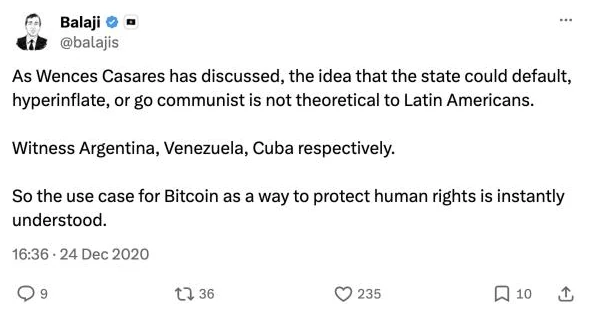
Wences Casares, CEO of Xapo, offers a global perspective, championing bitcoin as a vehicle for financial inclusion. Casares sees bitcoin as a democratising force resistant to governmental controls and censorship in a world where monetary policies can often disenfranchise entire populations.
Preston Pysh, merging financial acumen with technological foresight, emphasises bitcoin's revolutionary timechain. This unique feature allows the settlement of value over time, a facet unmatched by any historical currency.
But beyond these endorsements, the value of bitcoin is increasingly tied to the network effect. As more individuals and institutions, including BlackRock, adopt and use bitcoin, its utility and, by extension, its value increases. This self-reinforcing cycle, where increased adoption leads to greater value, is a hallmark of transformative technologies.
With a capped limit of 21 million, and highly divisible units, bitcoin emerges as an unparalleled asset in scarcity. Its open-source ledger positions bitcoin as a globally verifiable monetary system, a feature notably absent in traditional financial structures. This transparency significantly addresses the challenges of financial wrongdoing. In an era where traditional currencies can be printed without tangible backing, bitcoin's fixed supply offers a link to energy. It bridges cyberspace and tangible value, echoing the gold standard's principles but optimised for the digital age.
As humanity progresses deeper into the digital epoch, the paradigms of value and money are shifting. With its fusion of ancient monetary principles and cutting-edge technology, bitcoin challenges our notions of 'real' money. As its network grows and its principles become more understood, the line between traditional and digital value becomes increasingly blurred. One thing is clear: the discourse on what constitutes 'real' money is far from over, and bitcoin is firmly at its centre.